
Cal Poly SLO Admissions: What "Recommended" Coursework Really Means
A parent recently asked me whether her daughter needed four years of a foreign language to get into Cal Poly San Luis Obispo. She had heard the rumor, seen the fine print on Cal Poly's admissions page, and could not get a straight answer. Some counsellors told her it was non-negotiable. Others said they had students admitted with only two years and no problem.
That contradiction is not a quirk. It is a window into how Cal Poly's admissions process actually works, and why the "recommended" label trips up so many families. The honest answer requires understanding three things at once: what Cal Poly officially says, how the math of their selection formula actually moves, and why the current admissions environment has made course rigor a more powerful lever than it used to be.
What Cal Poly Officially Recommends
Cal Poly publishes a clear table on its first-year admissions site. The university uses the word recommended, not preferred or expected, and the gap between CSU minimums and Cal Poly's recommendations is significant:
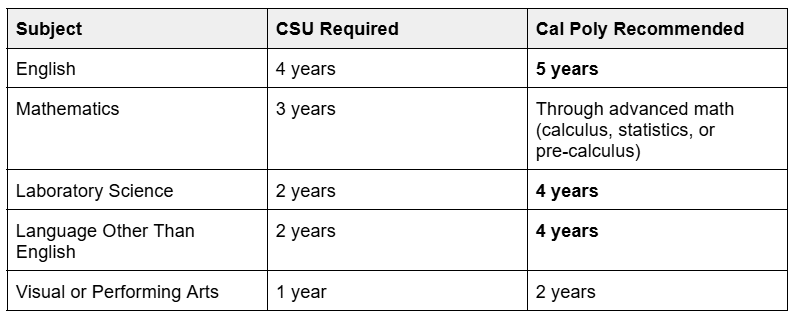
That extra year of English and the additional two years of language are the recommendations that generate the most family panic. Most California and Florida high schools do not naturally produce a five-year English transcript. Getting there usually requires dual enrollment at a community college, an additional English course in the summer, or a creative-writing elective stacked on top of the standard sequence.
So when Cal Poly publishes "5 years of English," they are not describing what most strong applicants arrive with. They are describing what their selection formula rewards.
How the Multi-Criteria Admission Formula Actually Works
Among selective universities, Cal Poly's process is unusually formula-driven. They consider no essays, no letters of recommendation, no interviews, no demonstrated interest, and (since the California State University system went test-blind in 2022) no SAT or ACT scores. The Cal Poly Selection Criteria page describes the process plainly: a "faculty-mandated Multi-Criteria Admission" formula, run by algorithm, evaluating each applicant against others applying to the same major.
The university ranks only two factors as "very important" in its Common Data Set: rigor of secondary school record and academic GPA. James Maraviglia, Cal Poly's longtime Associate Vice Provost for Marketing and Enrollment, told the campus paper years ago that "the screening and scoring is an automated process. There are algorithms that crunch data and then spit out scores." That is still how it works, only now the algorithm has fewer inputs.
When test scores left the formula in 2022, the weight on coursework and GPA went up. There is no longer a 1500 SAT to compensate for a transcript that stops at the CSU minimums. The transcript IS the application.
Within that formula, "recommended" coursework is not a hard requirement. It is a points adder. Independent admissions consultants who have analyzed historical MCA outcomes generally describe the structure as:
weighted GPA in core coursework drives the largest share of the score
bonus points accrue for rigor (honors, AP, IB, dual enrollment, college-level coursework)
additional points accrue for taking subjects beyond the CSU minimum, including the recommended 5th year of English, 4th year of language, 4th year of lab science, and advanced math
senior-year course load matters; a light spring schedule signals the wrong thing
Cal Poly does not publish the exact MCA weights, but independent counselors who have reverse-engineered admit and deny patterns over many cycles consistently report that advanced math coursework appears to carry disproportionate weight in the formula. Pushing a strong applicant to take calculus or AP Statistics generally moves the needle harder than adding a 5th year of English or a 4th year of Spanish. Treat that as an empirical pattern, not an institutional disclosure.
Why the "Recommended" Label Is So Confusing
Independent educational consultants in Florida and California have been trading admit and deny data on Cal Poly for years, and the pattern is consistent. Many students get in without the full recommended slate. Many do not. The decisive variable is rarely a single missing year of coursework. It is the interaction between major selectivity, GPA, and overall rigor.
A few representative reports from independent counselor caseloads (small samples, anonymized, not institutional data):
One California-based independent counselor reviewed her last eight years of Cal Poly admits across many different majors and found that only one had taken five years of English. Most were admitted to competitive programs with the standard four years.
A second independent counselor reported that across the past two admissions cycles, several borderline students who did add a 5th year of English at a community college were not admitted, while peers without that course were. In her caseload, the extra English year was not the deciding factor.
A third counselor pulled five years of her own student data and found a different pattern: among her admits, almost everyone with calculus and a 5th year of English (typically taken via community college dual enrollment) cleared the bar in competitive majors. Those without both more often did not.
How can all three be right? Because Cal Poly's selection is major-specific, and the threshold for "competitive enough" varies enormously by program. The same applicant profile that cruises into Agricultural Communications can get rejected from Computer Science. Aggregate counselor experience suggests course rigor matters at the margins. Major choice and GPA usually decide the case.
Why Major Selection Matters More Than Course Selection
Cal Poly's Fall 2025 first-year profile tells the real story. Cal Poly received 81,899 applications and admitted just 28.8%, with a mid-50% admitted GPA range of 4.04 to 4.25. Inside that overall number, the variation is dramatic:
Engineering: 23.4% admit rate, mid-50% GPA 4.14–4.25
Architecture & Environmental Design: 27.0% admit rate
Business (Orfalea): 27.4% admit rate
Science & Mathematics: 30.3% admit rate
Liberal Arts: 30.9% admit rate
Agriculture, Food & Environmental Sciences: 41.5% admit rate
Inside specific majors, the numbers tighten further. According to a Noozhawk analysis of Cal Poly's data, Psychology admitted just 2.1% of applicants in the most recent cycle. Biological Sciences admitted around 3%. Aerospace Engineering admitted 3.5%. These are admit rates that rival the most selective private universities in the country, hidden inside a CSU campus that many out-of-state families still treat as a safety.
That selectivity is not slowing down. Cal Poly's applications grew from roughly 64,000 in Fall 2023 to about 79,000 in Fall 2024, then hit a new record at 81,899 for Fall 2025. Seats stay roughly flat. The competitive baseline rises.
The Practical Strategy for Families
Once you understand the formula, the right approach gets clearer. The recommendations are not arbitrary. Each one moves the score. But the marginal value of each additional course is not equal, and squeezing in the wrong one can hurt.
Strategic priorities for any student targeting Cal Poly SLO:
Protect weighted GPA first. If a 5th year of English at a community college risks a B that drops the weighted GPA, the bonus points may not cover the loss. The same is true of a 4th year of language when the student is already overloaded.
Push math as far as possible. Calculus or AP Statistics in senior year does more for the MCA score than almost any other elective. For STEM majors this is non-negotiable; for non-STEM majors it is still the highest-leverage choice. Students who need to fortify the prerequisites before stepping into AP Calc or AP Stats often benefit from targeted math tutoring earlier in the sequence rather than improvising senior year.
Carry rigor through senior year. Cal Poly reads spring senior schedules. A light 12th-grade load is one of the few ways to give back hard-earned points.
Choose the major strategically. A 4.1 GPA into Psychology is harder than a 3.9 GPA into Agricultural Communications. Cal Poly allows applicants to designate an alternate major. Use it deliberately.
Do not drop reported coursework. Cal State Apply (the application platform Cal Poly uses) lets you self-report your senior-year coursework, but Cal Poly cross-checks it against your final transcript. Students who report a 5th year of English or a 4th year of language to bump their MCA score and then drop the course can have their admission revoked.
Stop chasing factors that do not count. Essays, recommendation letters, demonstrated interest, and resumes do not enter the formula. Spend that effort on coursework, GPA, and the major-fit narrative inside the activities list.
For students headed toward selective public universities like Cal Poly, the University of California, the University of Florida, or Florida State, the underlying principle is the same: the strategic choices made in 9th and 10th grade constrain what is possible by 12th. Once a student is a junior, the pathway is mostly set. The work to do is making sure the courses already in motion produce the highest possible weighted GPA, and that the senior schedule is full and rigorous.
Why This Matters Beyond Cal Poly
Cal Poly is the cleanest illustration of a broader trend, but the trend is not unique. Across selective public flagships, the loss of test scores has shifted weight onto GPA and rigor. The transcripts that win admission look different than they did a decade ago. They show:
four years of math, ideally through calculus or statistics
four years of laboratory science, not two
four years of a single foreign language, not two
five years of English at the most competitive institutions
consistent honors, AP, IB, or dual enrollment
a senior-year schedule that does not coast
Families who understand this early have time to build it. Families who discover it junior year are usually playing defense. The earliest question to ask is not "what is the test score target?" but "is the four-year course plan strong enough for the schools we are targeting?" That is a conversation worth having with a counselor before the freshman schedule is locked in, not after.
It is also why the GPA recalculation that colleges run matters more than the GPA on the high school transcript. Cal Poly's MCA, Florida's GPA recalculation for the State University System, and the UC's own recalculated GPA all strip and re-weight differently. A 4.5 on a high school transcript can become a 4.0 in the eyes of an admissions algorithm. Knowing the recalculation rules in advance is part of strategic planning.
The Bottom Line
Cal Poly's "recommended" coursework is not a polite suggestion and it is not an absolute requirement. It is the visible part of an automated formula that quietly rewards rigor and quietly punishes shortcuts. Most strong applicants do not arrive with every recommended box checked, and they still get in. Most weak applicants do not get in even when they do check the boxes. The formula does what formulas do: it weighs everything together and produces a score.
For families navigating selective public admissions, the practical answer is to stop treating "recommended" as binary. Treat it as a set of dials. Turn the math dial as far as it goes. Turn the senior-rigor dial up. Be careful which other dials you turn if turning them risks the GPA. And choose the major with eyes open, because that single choice often matters more than every coursework decision combined.
That is not a loophole. It is just how the math works.
JRA Educational Consulting helps families build strategic four-year course plans, navigate selective public and private admissions, and understand the formulas that schools like Cal Poly SLO actually use. Score At The Top Learning Centers & Schools provides the academic tutoring, AP coaching, and study-skills support that turns a strong course plan into a strong transcript. Together, the two brands give families a complete advantage from 9th-grade course selection through final admissions decisions. Learn more at jraeducationalconsulting.com and scoreatthetop.com.
