
Colleges With Free Tuition for Families Under $200,000: The Full List – and Why Getting In Is Now the Hard Part
On August 6, 2026, Boston University announced the "BU Promise": beginning with students entering in fall 2026, families earning up to $200,000 a year with typical assets will pay no tuition. The program goes further than most headlines suggest. Families earning under $75,000 pay nothing at all, including housing and dining, and even at the top of the range, a family earning $199,000 will pay no more than $20,000 a year for an education whose sticker price runs more than three times that.
Boston University is not an outlier. It is the latest entrant in what Forbes has called a "free tuition arms race" among selective private universities. Over the past two years, Harvard University, the Massachusetts Institute of Technology, the University of Pennsylvania, Yale University, and Emory University have all raised their free-tuition thresholds to $200,000, Rice University has announced the same for fall 2027, and Princeton University and the University of Chicago have gone to $250,000.
For families earning between $100,000 and $200,000 (too much for traditional need-based aid at most schools, too little to write $90,000 checks without pain) this is the most significant affordability shift in a generation. But there is a catch, and it changes how families should approach the entire admissions process.
The list: colleges with free tuition for middle-income families
Here are the major private universities among the free tuition colleges announced as of August 2026, based on institutional announcements and compiled reporting. Every program assumes "typical assets," which in plain English means savings and home equity roughly in line with your income. Families with a business, rental property, or large investment accounts may not qualify at the same income level, and each school runs that test differently.
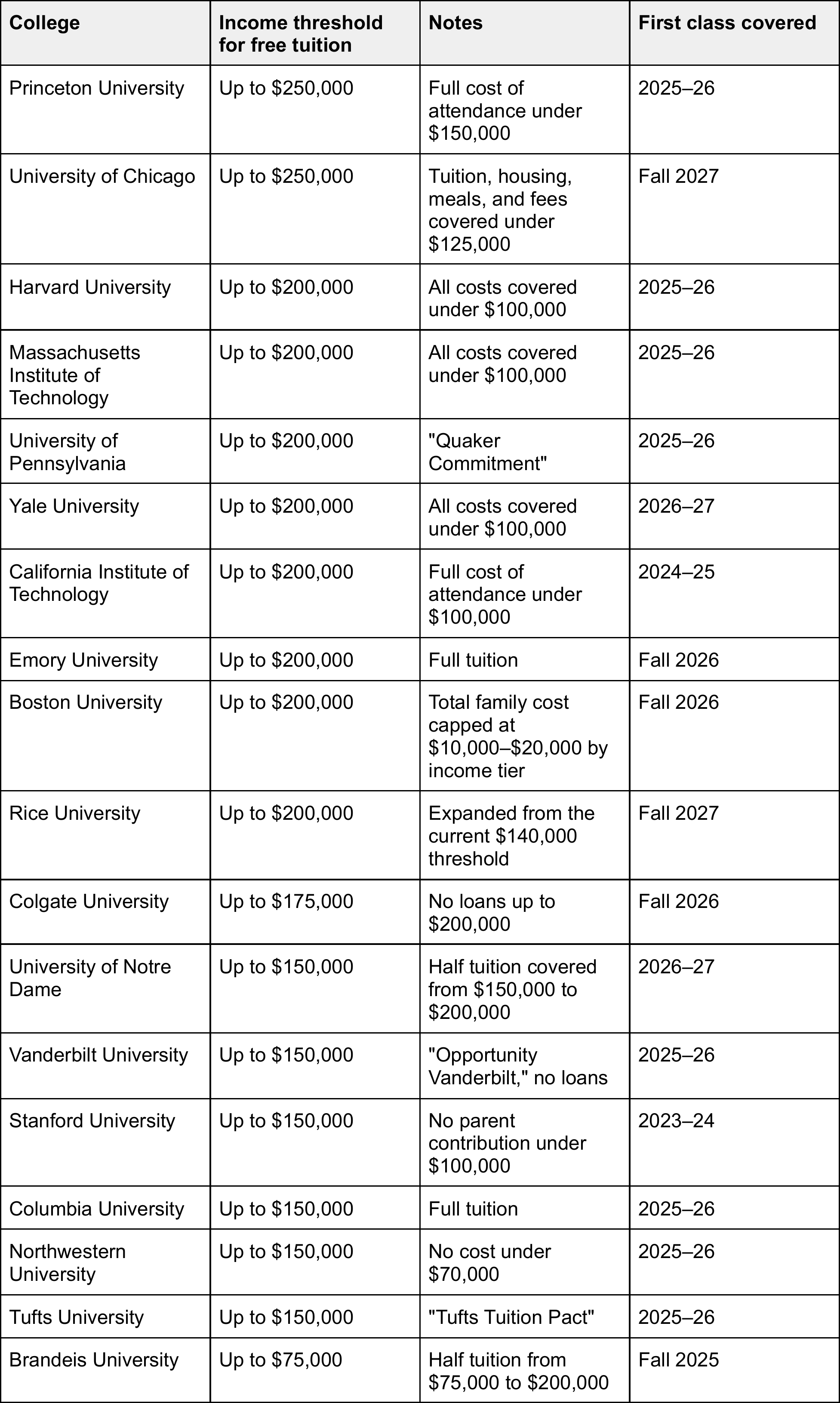
One clarification before the enthusiasm runs away: free tuition is not free college. Unless a program's notes say all costs are covered, housing, food, and fees remain the family's responsibility, and at these schools that can add $20,000 or more per year. The BU Promise caps those charges; most programs do not. Before treating any school on this list as affordable, run your numbers through its net price calculator, the estimator every college posts on its financial aid site.
Two regional programs deserve mention: Wake Forest University covers tuition up to $200,000 for North Carolina residents, and Duke University does the same up to $150,000 for students from the Carolinas. Public flagships have moved too, though thresholds are lower and generally limited to in-state students, led by the University of Michigan at $125,000 and the University of Virginia, the University of Texas system, and the University of California system at $100,000.
Even so, tuition alone at the private universities above now runs $60,000 or more per year. A free-tuition award is worth well over $200,000 across four years, and unlike merit scholarships, it is guaranteed to every admitted student who meets the income and asset criteria.
The catch: the money is guaranteed, but admission is not
Look at who is on that list. These are not generous mid-tier schools trying to fill seats. They are among the most selective institutions in the country, and the generosity is concentrated at the very top of the selectivity pyramid.
Yale University admitted 4.59% of applicants for fall 2025 entry. Rice University admitted 7.8%, the University of Notre Dame about 9%, and Duke University and Vanderbilt University both reported record-low acceptance rates in the same cycle. Even Boston University, long viewed as a more accessible alternative to its Boston neighbors, admitted just 12.8% of nearly 77,000 applicants that year, per its published admissions data. These announcements will push application volume higher still: free tuition for the middle class is a powerful recruiting message, and every additional applicant it attracts makes the odds a little longer.
This inverts the logic families have used for decades. The old assumption was that elite private universities were financially out of reach, so middle-income families defaulted to in-state publics and merit-aid schools before the conversation even started. The new reality is the opposite: for a family earning $150,000, an acceptance letter from Yale University, Emory University, or Boston University may now be the single cheapest path to a private education in America.
Florida families should hear this in local terms. Bright Futures plus low in-state tuition has long made the State University System the default financial answer, and it remains a strong one. What has changed is the comparison: a Florida student admitted to a free-tuition private university may now pay less than an out-of-state public would charge, which means the private reach schools belong back in the conversation.
The financial outcome and the admissions outcome have become the same thing. The aid is automatic. The acceptance is the prize.
Where professional guidance earns its keep
When admission itself carries a six-figure financial value, the quality of a student's application strategy stops being an academic nicety and becomes a financial decision. This is precisely the situation where an experienced college admissions consulting team changes the math; I have written before about what independent educational consultants actually do, and here the case is unusually concrete. Four areas matter most.
Build the list across the free-tuition tier
A family targeting these programs should not pin its hopes on one or two names. Treat the list above as its own category and build a balanced slate within it: a couple of reaches in the 4–8% band, realistic targets like Boston University or Brandeis University, and financially safe alternatives underneath, each vetted for admissibility and net cost rather than prestige alone.
Get the early-application decision right
Early strategy differs sharply across this list, and getting it wrong is expensive. Boston University, Emory University, Vanderbilt University, and Tufts University offer binding Early Decision, where a family that clearly qualifies under the income threshold takes on little financial risk by committing, because the aid is formula-driven rather than negotiated. Harvard University, Yale University, Princeton University, Stanford University, and the Massachusetts Institute of Technology offer no Early Decision at all, only early programs that restrict where else you may apply early. Choosing which single early card to play is the highest-leverage decision in the cycle, a point we develop in why applying early has never mattered more.
Position academics and testing early
Schools admitting fewer than 13% of applicants admit students who present evidence, not potential: rigor in course selection, a coherent extracurricular narrative, and strong test scores. Most of the schools on this list now require or strongly favor SAT or ACT scores, so a structured SAT preparation program belongs in the plan by sophomore or junior year, not as a senior-fall scramble.
Read the fine print on assets
These programs qualify families through the FAFSA and, at most schools, the CSS Profile, the more detailed financial form many private colleges require beyond the FAFSA. Each defines "typical assets" differently, so a family with rental property or a small business can earn $160,000 and still fall outside a program's terms. Modeling eligibility before building the list, and reading financial aid award letters carefully in the spring, prevents an expensive surprise in April.
What families should do this fall
For current juniors and sophomores, the sequence is straightforward:
Run the numbers honestly. Confirm your household income and asset picture against each program's threshold, then verify with the school's net price calculator. Eligibility drives the list, so this comes first.
Build the list with real range. Anchor it in the free-tuition tier, but span the selectivity spectrum within it, following the same discipline we apply in building a college list.
Finish testing with time to retest. A score that clears a school's middle range strengthens both admission odds and the case for applying early.
Settle the early-application decision by summer. The choice of where to apply Early Decision or restrictive Early Action should be made strategically in July, not reactively in October.
The colleges have done something genuinely important here: they have removed the financial barrier for a huge swath of American families. What they have not removed – what has, in fact, grown taller – is the admissions barrier standing in front of it.
Frequently Asked Questions
Which colleges offer free tuition for families making under $200,000?
As of August 2026, Harvard University, the Massachusetts Institute of Technology, Yale University, the University of Pennsylvania, the California Institute of Technology, Emory University, Boston University, and Rice University (beginning fall 2027) all cover full tuition for families earning up to $200,000 with typical assets. Princeton University and the University of Chicago cover tuition up to $250,000.
Is Boston University really free for families earning under $200,000?
Tuition is free, and total cost is capped. Under the BU Promise, starting fall 2026, domestic first-year students from families earning under $200,000 with typical assets pay no tuition, and family contributions toward housing and dining are capped between $10,000 and $20,000 a year depending on income. Families under $75,000 pay nothing at all.
Do you have to apply separately for these free-tuition programs?
No. Eligibility is determined automatically through the standard financial aid process, typically the FAFSA plus the CSS Profile. There is no separate scholarship application. The important caveat is assets: each school defines "typical assets" differently, so families with businesses, rental property, or substantial savings should model their eligibility before assuming they qualify.
If the aid is guaranteed, why would we need an admissions consultant?
Because the aid only exists for admitted students, and the private universities on this list admit between roughly 4% and 13% of applicants. The financial value of the programs is captured entirely at the admissions stage. Professional guidance on list building, early-application strategy, positioning, and essays is aimed at exactly that stage, where a single changed outcome can be worth more than $200,000.
JRA Educational Consulting helps families navigate every stage of the admissions process – from school selection and application strategy to financial aid review and final decisions. To learn more, visit JRA Educational Consulting.
