
How to Navigate College Waitlists in 2026: A Strategic Guide for Students and Families
Ivy Day has come and gone. Across the country, students are opening portals and reading decisions — some celebrated, some were heartbroken, and many that landed somewhere in between: the waitlist.
If your student received a waitlist notification this spring, you are not alone. With 9.4 million applications submitted through the Common App this cycle — a 5% increase over last year — colleges are managing unprecedented volume. Students are applying to an average of 6.59 schools each, which makes predicting enrolment yield harder than ever. The result? Schools are placing more students on waitlists as a hedge against uncertainty.
But here is what families need to understand: a waitlist is not a rejection. It represents a college’s strategic position — and how you respond to it matters.
Why Waitlists Are Larger and More Unpredictable Than Ever
The math behind waitlists has shifted dramatically. When students apply to six or seven schools instead of three or four, colleges can no longer predict with confidence how many admitted students will actually enroll. To protect themselves, they build larger waitlists — whose numbers reflect that trend.
Consider the data:
Nationally, colleges admit roughly 20% of students who accept a spot on the waitlist. At the most selective institutions, that number drops to just 7%.
For the most recent fully reported cycle, 62% of schools admitted 10% or fewer waitlisted students.
At schools like Cornell, which waitlisted over 7,700 students in one recent cycle and admitted just 24 off that list, the odds can feel overwhelming.
But those national averages mask real variation. Princeton admitted 150 students (15%) off its waitlist in one recent cycle. UCLA admitted 1,514 students (over 11%) off its waitlist in another. The takeaway: waitlist outcomes are unpredictable, which is exactly why strategy matters.
What Makes This Year Different in 2026
Several factors are shaping the waitlist environment for the Class of 2030:
Record-low acceptance rates. Harvard and Columbia are below 4%. Brown came in at 5.35%. Duke is now receiving nearly 60,000 applications — up from 36,000 just seven years ago. At these numbers, being waitlisted says nothing about a student's ability. It is simple arithmetic.
The return to standardized testing. Most Ivy League schools now require test scores again for the Class of 2030. Test score submissions are up 11% as of December 2025. This shift may eventually reduce application volume at the most selective schools, but for now, competition remains fierce.
Financial aid realities. Here is something many families do not realize: colleges that are "need-blind" during the regular admissions cycle often become "need-aware" when pulling from the waitlist. That means a student's ability to pay can factor into late-round decisions. Merit scholarships are typically depleted by May, so waitlist admits may receive less favorable financial aid packages. Only a handful of schools — Amherst, Babson, Bard, Baylor, and Wellesley — have stated they remain need-blind for waitlisted students.
The enrolment cliff on the horizon. Colleges face a projected 15% drop in 18-year-olds by 2029, which is already driving closures of smaller institutions. Highly selective schools remain insulated, but mid-tier schools may show more waitlist movement as they compete to fill seats.
Your Waitlist Action Plan: What to Do Right Now
If your student has been waitlisted, there are concrete steps that can meaningfully strengthen his or her position.
1. Accept the Waitlist Spot Immediately
This is not automatic. Colleges require students to formally opt in — usually through their admissions portal. If you want to remain in contention, confirm your interest as soon as possible. Failing to do so is effectively declining.
2. Read Every Instruction Carefully
This cannot be overstated. Schools have different — sometimes contradictory — protocols for what they want from waitlisted students. Some invite a brief written update. Others explicitly say they do not want any additional materials. Some ask you to reconfirm interest at different points through the spring. Follow the instructions to the letter. Ignoring them is the fastest way to hurt your candidacy.
3. Write a Compelling Letter of Continued Interest (LOCI)
If the school allows additional communication, the LOCI is your most powerful tool. Here is what makes one effective:
Keep it to about 500 words — roughly one page.
Send it by mid-April, with a possible brief follow-up in early May.
Lead with specific fit, not generic praise. Reference particular courses, professors, research opportunities, clubs, or campus traditions that align with your goals.
Include genuine updates — new grades, awards, leadership roles, or meaningful experiences since you applied. Only include updates if they add real substance.
State your commitment clearly. If this school is your first choice, say so: "If admitted, I will enroll." But you can only make this commitment to one school, so use it wisely.
Address it to your regional admissions officer and copy the general admissions inbox.
Here is an encouraging fact: Letters of Continued Interest are rarer than you might think. Many waitlisted students never send one, which means a thoughtful, well-crafted letter genuinely stands out.
4. Consider One Additional Recommendation
If the school does not prohibit it, a new letter of recommendation from someone who offers a different perspective — a recent mentor, employer, or coach — can add dimension to your application. This should supplement, not repeat, what is already in your file.
5. Keep Your Grades Strong
Spring semester performance matters. Some colleges specifically request updated transcripts from waitlisted students. Even when they do not ask, a grade dip can jeopardize your position. Stay focused through the end of the year.
6. Deposit at Another School by May 1
This is non-negotiable. The national enrollment deposit deadline is May 1, and you must commit to a school where you have been admitted. Depositing at one school while remaining on a waitlist elsewhere is completely acceptable — this is not double depositing. However, if you are later admitted off the waitlist, notify your original school immediately so they can offer your spot to another student.
7. Keep Your Counselor in the Loop
Your high school guidance counselor and any private college counselor should know your waitlist plans. They may be able to advocate on your behalf, stay in contact with admissions offices, and help you craft a strategic approach.
What NOT to Do While Waitlisted
Knowing what to avoid is just as important as knowing what to do.
Do not call the admissions office repeatedly. The vast majority of colleges will not know the status of their waitlist until mid-May at the earliest. Repeated phone calls through April are more likely to flag your name negatively than to help. One strong LOCI plus one follow-up is the right cadence.
Do not send a "brag sheet." The most common mistake students make is stuffing their letter with every credential they can think of. Admissions officers are not looking for another resume — they want to see genuine connection to their institution.
Do not tell multiple schools "I will definitely enroll." Admissions officers take this seriously. If you make that commitment to more than one school, it undermines your credibility across the board.
Do not let anxiety consume the process. This is easier said than done, but once you have sent your LOCI and confirmed your interest, you have done everything within your control. The smartest mindset is to get genuinely excited about the school where you have deposited — because statistically, that is likely where you will enroll. If a waitlist offer comes through, it is a wonderful surprise that you can evaluate with a clear head.
The Timeline: When Waitlist Decisions Actually Happen
Understanding the cadence helps manage expectations:
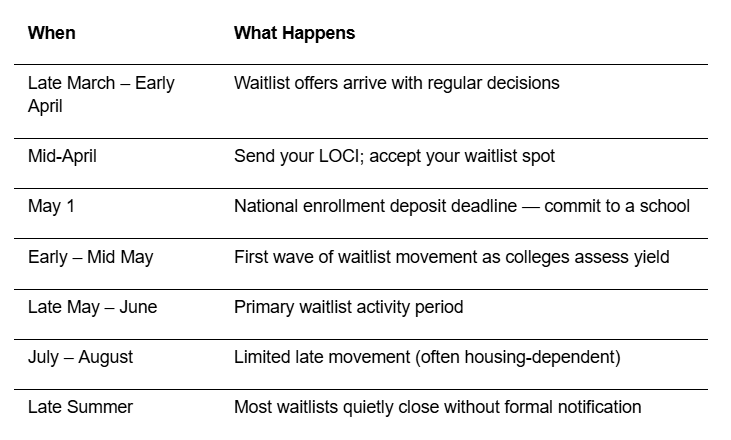
One important note: many schools never formally close their waitlists. Silence, in most cases, effectively means no. If you have not heard by mid-July, it is reasonable to move forward with your committed school.
The Bigger Picture: Positioning Starts Before Senior Year
Navigating a waitlist is stressful, but it is also a reminder that competitive college admissions is a long game. The students who are best positioned — whether admitted outright, waitlisted, or redirected — are those who have spent years developing academic rigor, meaningful extracurricular engagement, and a clear sense of who they are and what they want to study.
Strategic test preparation, intentional high school course selection, and authentic involvement in activities that reflect genuine passion — these are the foundations that create strong applications in the first place and strong LOCI letters when needed.
How Score At The Top Helps Families Navigate the Waitlist
At Score At The Top Learning Centers & Schools, we work with families through every stage of the college admissions process — including unexpected ones. Our team of 140+ educators brings 40 years of experience in tutoring, test preparation, college counseling, and academic coaching.
When a waitlist decision arrives, we help students:
Evaluate the original application to identify areas for stronger positioning
Craft compelling Letters of Continued Interest that demonstrate authentic fit and meaningful growth
Develop a strategic communication plan with the right timing, tone, and substance
Navigate financial aid implications so families make informed decisions
Maintain academic momentum through personalized tutoring and coaching during a stressful period
A waitlist is not the end of the road. With the right guidance, it can be the beginning of a strategic path forward.
Contact JRA Educational Consulting today to discuss your student's waitlist strategy and next steps.
