
The Lure of the South: Why Students Are Heading South for College (2025 Update)
A Migration Redefining College Admissions
Over the past decade, a significant migration has reshaped the U.S. college landscape: students from the Northeast and Midwest are heading south in record numbers.
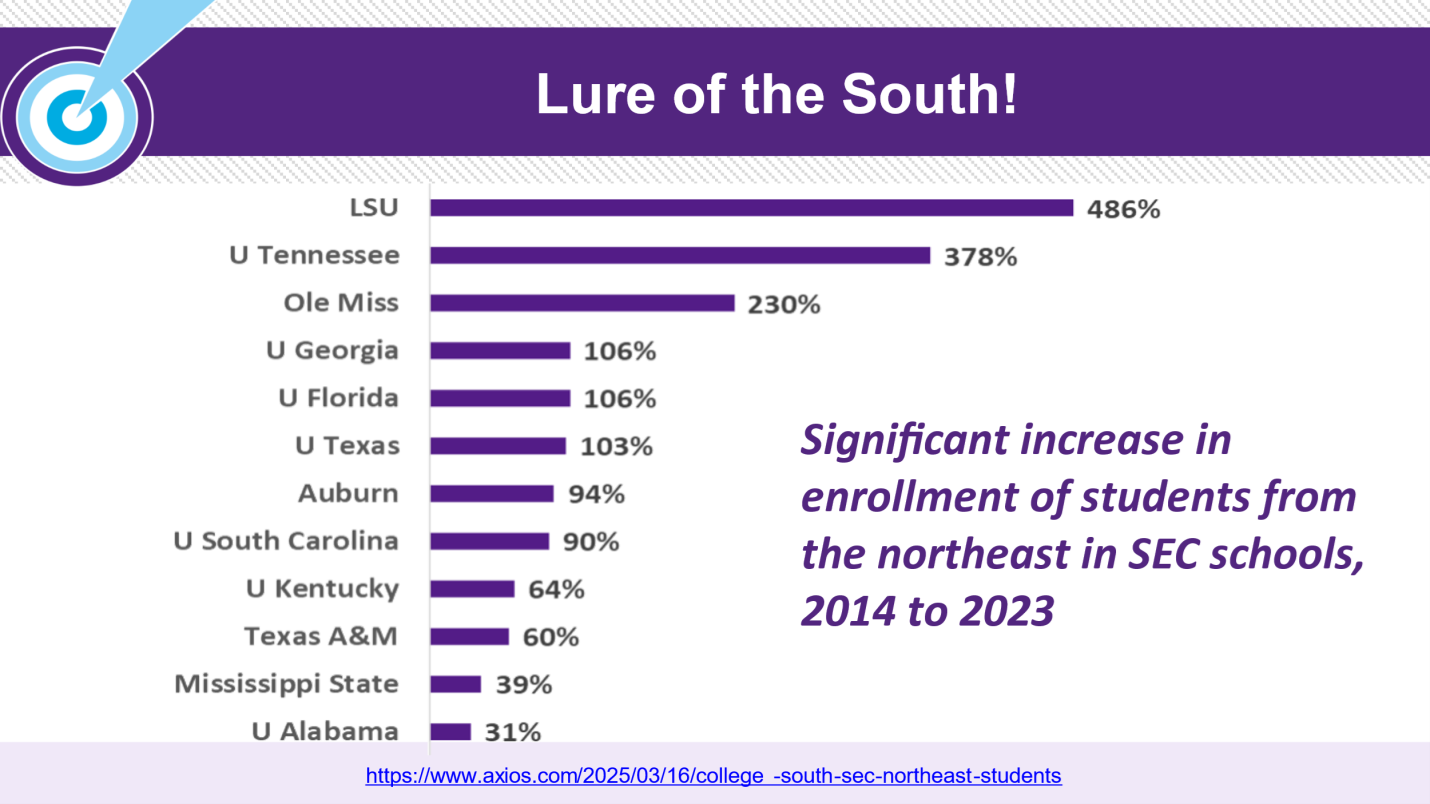
According to a 2025 Wall Street Journal analysis of U.S. Department of Education data, the number of Northern students attending Southern public universities has risen 84% over two decades — and 30% since 2018. An Axios report confirmed the trend, showing that students from major Northeastern cities are increasingly enrolling at flagship institutions such as the University of Alabama, University of Georgia, and University of Florida.
What’s Driving the Southern Shift
1. Economic Value and Predictable Affordability
Southern universities deliver a significant financial advantage—often 10–30% less than comparable Northeastern privates, even for out-of-state students.[J1]
Key affordability levers include:
Merit-based scholarships: Many states, including Florida, Georgia, and South Carolina, offer merit programs that reduce the cost for nonresidents.
Florida Bright Futures Scholarships: These awards cover a substantial portion of in-state tuition and have become a national model for predictable affordability. (https://floridabrightfutures.gov/)
For many Northern families facing steep tuition at private institutions, these savings are transformative.
The 2025 CNBC Decision Day report found that affordability is now the top factor in college choice for U.S. families—further strengthening the appeal of Southern public institutions.
2. Campus Culture and Community
Southern campuses emphasize belonging, connection, and school spirit—qualities many families say feel diminished at large Northeastern institutions.
Students highlight:
Close-knit residential life and visible school spirit
Active alumni mentorship and job placement pipelines
Strong engagement through athletics, Greek life, and community service
As Axios summarized, “the South is selling sunshine and stability—and students are buying.”
3. Academic Prestige and National Reach
Southern universities have evolved from regional standouts into national academic powerhouses. Institutions such as Vanderbilt, Emory, Georgia Tech, UNC-Chapel Hill, and the University of Florida routinely appear in national top-25 rankings, competing with traditional Ivy League peers on research, facilities, and post-graduation outcomes. As academic profiles rise, these universities are reshaping perceptions of regional prestige.
University of Florida received 91,896 applications for 2025, a 22.8% year-over-year increase, with applicants from all 50 states (https://admissions.ufl.edu/freshman-student-profile).
University of Texas at Austin nearly doubled its Northeastern freshman population between 2014 and 2023, despite caps limiting out-of-state seats (https://www.axios.com/local/austin/2025/04/09/university-of-texas-austin-northeast-students-freshman).
4. Safety and Campus Climate
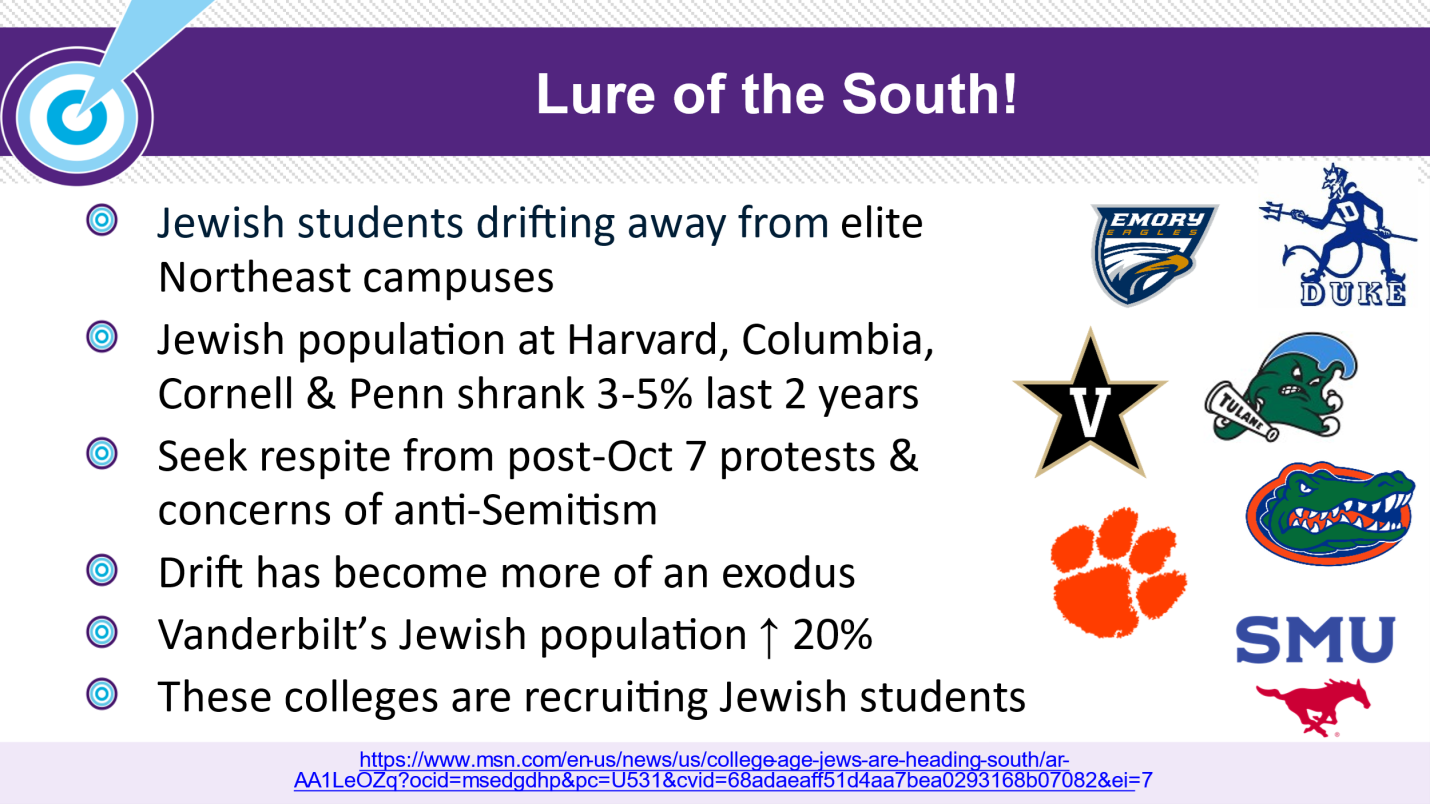
Social and political dynamics have also influenced enrollment patterns. Some families—especially Jewish students—have sought campuses perceived as stable, supportive, and less polarized.
An Atlantic feature (August 2025) reported that Vanderbilt University’s Jewish population grew approximately 20% over two years, while University of Florida Hillel participation increased by nearly 50% since 2021. Though precise data vary by institution, the message is clear: for many students, campus culture and climate are no longer secondary considerations.
While comprehensive national data are limited, these trends suggest that campus climate is increasingly important in college choice. Other student groups, including politically moderate families, also report seeking environments that balance safety, inclusivity, and community engagement.
How Southern Schools Engineered Their Growth
Recognizing the growing interest from Northern students, Southern universities have implemented targeted strategies to attract and retain high-achieving applicants. Their recruitment playbook includes:
Out-of-state outreach: High school visits and recruitment fairs in New York, Boston, and Philadelphia, contributing to measurable application growth.
Expanded honors programs: Small-class experiences and early research opportunities provide a competitive advantage for high-achieving students.
Direct-admit pathways: Strong candidates are guaranteed placement in their chosen majors.
Lifestyle marketing: Promoting year-round sunshine, modern facilities, and a close-knit campus culture.
As reported by the Chronicle of Higher Education, “Southern universities are increasingly competing for top students nationwide, offering programs and experiences that rival traditional Northeastern institutions.” This reflects a coordinated approach to enrollment growth, helping Southern universities become national destinations for students seeking academic excellence, affordability, and community.
Florida: The Epicenter of the Southern Surge
Florida’s leadership in this migration is no coincidence. The state’s population grew by more than 1.5 million residents between 2020 and 2024—the fastest rate in the nation, creating strong demand for local higher education. Combined with consistent state investment in affordability through Bright Futures and Florida Prepaid, in-state tuition averages just $6,400 a year, far below the national average. Add in the year-round warm climate, thriving campus culture, and nationally ranked institutions like the University of Florida and Florida State University, and it’s clear why Florida has become the destination of choice for many Northern families seeking both quality and value.
The University of Florida, Florida State University, and University of Miami have all reported double-digit application growth since 2020. With strong rankings, scholarship opportunities, and transparent affordability through Bright Futures and Florida Prepaid, the state now offers one of the nation’s best-value pathways to a top-tier degree.
Southern public universities now enroll more out-of-region students than ever before, with applications from the Northeast and Midwest up 30% since 2018, and this trend is expected to continue over the next decade.- U.S. Department of Education, WSJ 2025 analysis.
What This Means for Students and Families
For many families, heading South is not about compromise—it’s about strategy.
But as popularity rises, selectivity follows.
University of Georgia and Clemson have seen record out-of-state interest.
Vanderbilt’s admit rate has dipped below 6%, rivaling Ivy League levels.
UT Austin’s statutory cap on out-of-state students makes admission even more competitive.
Planning ahead is key:
Visit early—ideally by junior year—to demonstrate interest.
Apply Early Action whenever available (unless it’s a “restrictive” early action).
Explore honors programs and merit scholarship deadlines, which often fall earlier than regular admission.
Action Steps for Families
Compare Total Cost of Attendance: Include tuition, housing, travel, and potential merit.
Plan Visits Strategically: Attend admitted-student or honors preview weekends to gauge campus culture.
Evaluate Outcomes: Review each university’s first-destination data and alumni network strength.
Work with an Experienced College Consultant: A counselor can help identify schools that balance affordability, academic rigor, and campus fit, suggest strategies for early application or merit scholarship eligibility, and provide insights on honors programs or niche opportunities in your intended major.
Research scholarships and evaluate outcomes early: Identify state programs like Florida Bright Futures, institutional merit awards, or need-based grants. Compare the total cost after aid with post-graduation success metrics—such as average starting salary, employment rate, or graduate school placement—to understand the true return on investment.
Institutional Scholarships:
University of Florida
Presidential Scholarships – Awarded based on academic merit.
Presidential Platinum: $10,000 per year
Presidential Gold: $8,000 per year
Presidential Scholarship: $5,000 per year
Florida Opportunity Scholars Program – For first-generation, low-income Florida students.
Grandparent Waiver – Out-of-state tuition waiver for students with Florida-resident grandparents.
Florida State University
University Freshman Scholarship – Up to $9,600 over four years, awarded automatically based on high GPA and test scores.
Presidential Scholars Program – FSU’s premier merit award; covers full cost of attendance plus leadership and research opportunities.
FSU College or Departmental Scholarships – Each college (like Business or Arts & Sciences) offers its own competitive awards for continuing students.
University of Miami
President’s Scholarship – $16,000 to $28,000 annually, renewable for four years.
Isaac Bashevis Singer Scholarship – Full tuition, merit-based award.
Ronald A. Hammond Scholarship – Full cost of attendance, emphasizing leadership and academic excellence.
Canes Achievement Award – Need-based, renewable award for strong academic performers.
The Takeaway
The “Lure of the South” reflects more than a passing trend—it marks a fundamental redefinition of how American families view college.
Southern universities have become national destinations, offering a powerful blend of academic excellence, affordability, and community. For a growing number of students, going South isn’t simply a change of scenery—it’s a deliberate choice for opportunity, belonging, and balance.
