
Florida's Dozen Fall 2027: Application Deadlines and Rules
The University of Central Florida ran out of merit scholarship money after Early Action last cycle and told counselors to expect the same this year. The University of Florida has stopped sharing admission decisions with high school counselors. Florida Atlantic University will let some applicants skip the self-reported transcript entirely, but only if their public high school sends the transcript a specific way.
None of that appears in a school's viewbook. It came out on September 3 at the State University System of Florida's 51st annual fall counselor workshop, hosted at Florida Atlantic University, where the admissions directors of all 12 public universities brief counselors on the coming cycle. Members of our college guidance team were in the room. What follows is the part of that briefing a family can act on: the deadlines, the rules for STARS (the self-reported transcript most Florida schools now require), the money that disappears early, and the answers the directors gave when counselors pushed back.
Two schools' binding Early Decision plans, announced in April, got most of the attention over the summer. We have covered who should apply Early Decision to the University of Florida or Florida State University in detail, so this post treats the flagships briefly and gives the other ten members of Florida's Dozen the space they rarely get.
The Fall 2027 deadline table for all 12 Florida public universities
Dates are as stated by each university's admissions director at the workshop, checked against the school's website. Confirm on the school's site before relying on any of below dates.
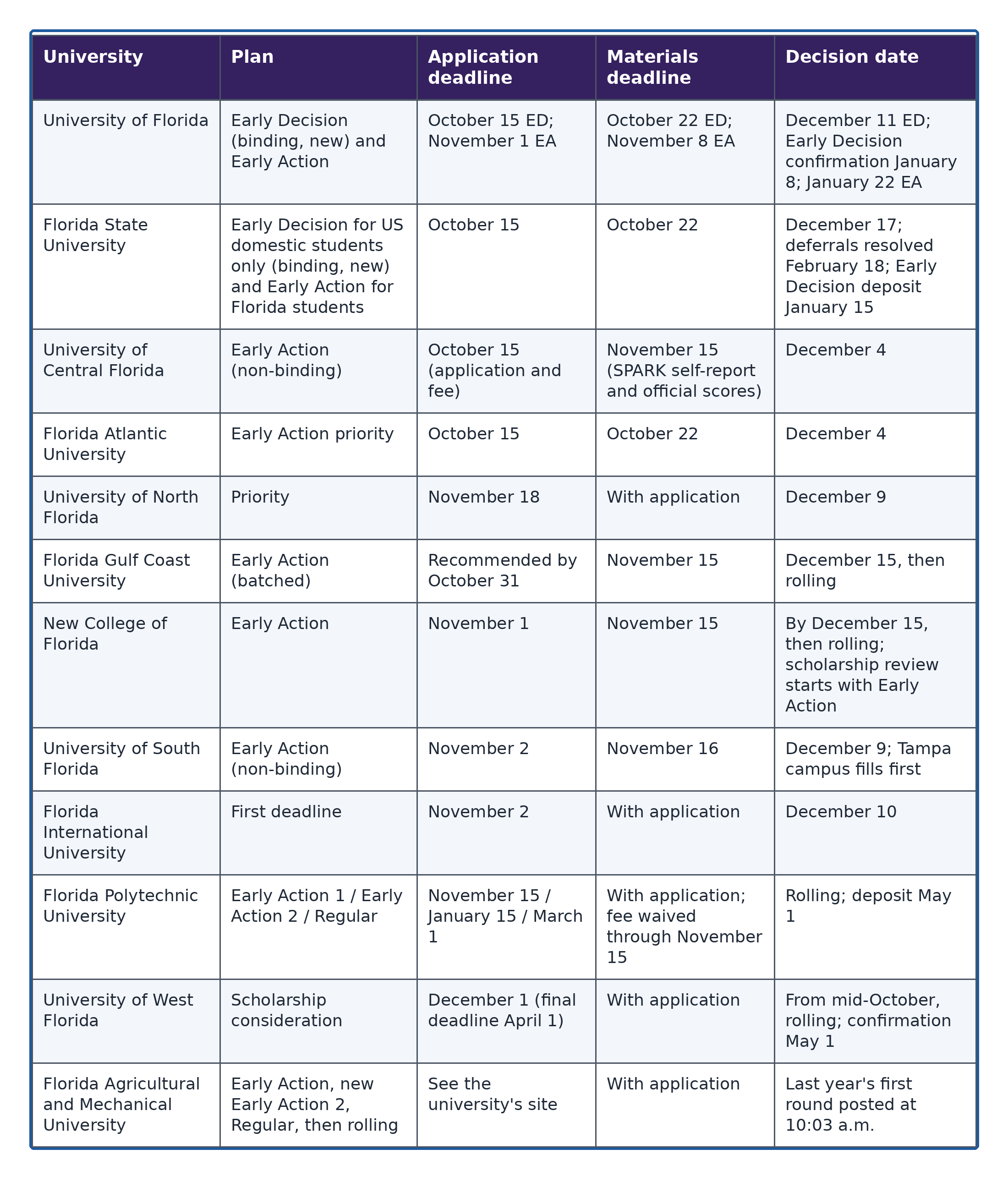
Nine of the twelve schools want the application in hand by the first week of November, and the three that do not still tie their scholarship money to an early date.
What the University of Florida and Florida State University changed beyond Early Decision
The University of Florida made the change counselors will feel first. It has dropped slate.org, the platform through which counselors saw admission decisions, after a year-long review found practices that conflicted with university policy, including parents calling with detailed knowledge of other students' outcomes. Decisions on December 11 go to students and families only. The director said he has not given up on finding a fair way to keep counselors informed, but no replacement exists yet. Expect that date to land without warning at school, and have the conversation about a deferral or denial before it, not after.
The University of Florida director also confirmed that the Early Decision contract must be signed by the student, a parent, and the school counselor, except for homeschool and fully virtual students, who need only the student and parent signatures. Admitted Early Decision students confirm by January 8. Gap-year and deferral policies will be posted by early October. The ten-year selectivity trend that makes the binding option tempting is charted on our University of Florida admissions data page.
The Florida State University director added detail to the April announcement. Early Decision applicants get identical scholarship consideration to everyone else, and the criteria do not change by plan. Students admitted in December under either early plan will receive their financial aid packages in January. In December, Florida State University will not admit an Early Decision applicant to any term other than the one they requested, and it will make no offers of admission to a pathway program or alternate campus; a student who would have received one is deferred to February and released from the binding commitment.
Florida State University's Early Decision is closed to international students, applicants to the CARE Summer Bridge program for first-generation and limited-income students, applicants to talent-based programs, and recruited athletes. If a student is on the fence, the director's own advice was to use Early Action, which remains open only to Florida residents and is non-binding
Who requires STARS, who dropped it, and the one waiver that helps only public school students
The self-reported transcript is where applications stall most often each fall. This year the twelve schools handle it four different ways.
Florida Atlantic University introduced a waiver with a narrow condition. If a Florida public high school sends the transcript electronically through the state's FASTER/SPEEDE system, the student does not complete STARS. Parchment does not count. Neither does a PDF, an email, or Scoir. Private and independent school students are not eligible for the waiver at all and must complete STARS as before. A public school student should ask the the school’s registrar or counselor which system the school uses before assuming anything.
Florida Agricultural and Mechanical University and Florida Gulf Coast University are not using STARS this cycle. Both want official transcripts, and Florida Agricultural and Mechanical University also wants dual enrollment transcripts. Florida International University requires official transcripts as well.
The University of Central Florida uses its own self-reported record, SPARK, and does not want a high school transcript at all. The director was blunt that a transcript on file does nothing; the file is incomplete until SPARK is submitted. SPARK reopens January 15 through February 15 for deferred applicants to add mid-year grades. Admitted students do not update it.
The University of Florida, Florida State University, University of South Florida, University of North Florida, University of West Florida, Florida Polytechnic University, New College of Florida all require STARS. The University of North Florida can now pull transcripts from the Common Application, but it still requires STARS because the self-report speeds its decisions.
Test scores follow their own rules. The University of North Florida will accept self-reported scores in its own portal but cannot take them from STARS or the Common Application. The University of South Florida wants scores directly from the testing vendor. Florida State University, according to its admissions site, does not accept scores self-reported through the Common Application. When a school requires official scores, order them in September.
Our complete list of colleges that require STARS for 2026–2027 covers schools beyond Florida, and our free STARS workshop walks through the entry itself course by course. The Florida State University and University of South Florida directors, and the panel as a whole, said they compare the self-report to the official transcript when it arrives and rescind offers over material discrepancies. Most errors are honest ones, entered from memory or by a parent. The consequence is the same.
Scholarship money that is gone before Regular Decision
Admission and money now run on different clocks at several of these schools, and the money clock is faster.
The University of Central Florida awarded roughly 22,000 of its 28,000 offers through Early Action last cycle and exhausted its merit scholarship budget on that group. Merit awards go out in January, separate from the December 4 decision, and Early Action applicants get priority. Fall admits averaged a 4.32 GPA, 1368 SAT, and 30 ACT, so the scholarship competition is stiff even inside the early group. For a family counting on merit aid, October 15 is the real deadline at the University of Central Florida, whatever the rolling calendar says.
Florida Gulf Coast University awards its merit tiers up front during the fall batch, including the bronze tier for Florida residents it added last year, and told counselors the money is not unlimited. Its combined summer and fall admitted GPA rose to about 4.20 this year, and the director intends to raise it again. The class filled early enough last cycle that some students were deferred to spring.
The University of West Florida ties nearly all of its money to December 1: automatic merit consideration, an invitation-only full-ride competition for Florida residents, and a full-ride award for National Merit Finalists that covers tuition, housing, meals, books, and a research or study-abroad experience. Its admission model is unchanged. A weighted GPA of 3.2 or higher gets full consideration for fall; below that, the student may be offered spring.
Florida Polytechnic University waived its application fee for everyone through November 15 and posts in-state tuition of $4,940, with merit awards up to full tuition. The University of North Florida matches all admitted students to scholarships automatically, with no separate application, and reports that 71% of its students received aid last year. New College of Florida charges no application fee, and its director said scholarship conversations start with the November 1 Early Action round.
Application-form traps at Florida Atlantic University, the University of South Florida, and the University of Central Florida
Florida Atlantic University consolidated to a single Common Application entry. More than 1,000 students applied more than once last year, often at a parent's urging, and the duplicates caused account and processing problems. The Wilkes Honors College no longer has its own application; it is a checkbox near the top of the Florida Atlantic University application, and all applicants are considered for honors, bridge programs, and alternate terms. Submit once, check the box, and let the university sort the rest.
The University of South Florida corrected a rumor its staff heard at the college fair table: students are not shunted to the St. Petersburg campus because they were weaker applicants. Both campuses have the same standards. If Tampa is full, an admissible student may be offered St. Petersburg; if both are full, the waitlist. A February applicant should not expect the preferred campus.
The University of Central Florida puts the admitted term in the first sentence of its letter, and a summer admit must enroll in summer; there is no rolling it to fall. Spring admits deposit by December 1 rather than May 1. The director also asked that students include a Social Security number on the application. It is optional, but its absence delayed financial aid and Bright Futures processing for a large number of students last year, and a family that prefers to withhold it should expect to supply it later for aid.
What the directors said when counselors pushed back
The panel at the end of the day is where the directors answer questions they did not choose.
A counselor whose school dropped calculus asked whether that ends an engineering application. No school said yes. Florida Atlantic University routes those students to a readiness track with a math boot camp. The University of Central Florida places them in its Math Launch program. Florida State University does not require calculus but wants the change noted on the school profile so readers judge rigor fairly. The University of North Florida's caution was practical: without calculus, the engineering sequence starts late and graduation can slip a semester.
On students who earn an associate degree in high school, a Board of Governors representative was specific. An associate degree earned through acceleration before high school graduation means the student is treated as a first-time freshman for admission, aid, and housing (the governing rule is Board of Governors Regulation 6.005). The same degree finished the summer after graduation makes the student a transfer, which changes all three. Families in that position should say so on the application and confirm the timing with the dual enrollment advisor.
A counselor challenged the published test-score ranges as unrealistic for students loaded with dual enrollment credit. The answer was direct. The ranges are the middle 50% of admitted students, so a quarter of admits scored below them. Test scores are one factor in a multi-part rubric at all twelve schools. And all twelve superscore. One director described a student who reached a 1300 superscore across seven sittings by preparing one section at a time. That approach is the core of how our SAT preparation program sequences a student's testing calendar, and it is why a single senior-year sitting is a poor basis for writing off a school.
Two shorter rulings. A senior who has finished the English and math sequences can fill the second semester with other rigorous courses without penalty, as long as the schedule still involves writing and analysis. And dual enrollment, Advanced Placement, and Cambridge AICE courses are treated the same in review, provided the student passes.
What a senior should do before October 15
Copy the deadlines for the student's actual list and note which schools have a second materials date. Florida State University and Florida Atlantic University close materials October 22, as does UF for its binding ED round; the University of Central Florida's November 15 SPARK deadline has caught families who thought October 15 ended the work.
Ask the high school which transcript delivery system it uses. That single answer determines whether Florida Atlantic University requires STARS.
Order official score reports now for each school that will not accept self-reported scores.
Complete STARS or SPARK from the transcript, and have a second person check it against the document before submitting.
Decide the Early Decision question at Florida State University with the financial aid timeline in mind, since December admits there will see aid information in January.
Apply for housing the day the portal opens. The University of West Florida reported its housing at maximum capacity, and the University of Central Florida called its housing "at a premium."
Families who want help with the list, the calendar, or the self-reported transcript can work with our college guidance team, which has advised students on Florida's public universities since 1980.
Frequently Asked Questions
Which Florida public universities do not require STARS for Fall 2027?
Florida Gulf Coast University, Florida Agricultural and Mechanical University, and Florida International University require official transcripts instead of STARS. The University of Central Florida uses its own SPARK self-report and does not want a transcript. Florida Atlantic University waives STARS only for Florida public school students when the transcript arrives through the state's FASTER or SPEEDE systems. The other seven, including the University of Florida and Florida State University, require STARS.
When is the University of Central Florida Early Action deadline for Fall 2027?
October 15 for the application and fee, and November 15 for SPARK and official test scores. Both dates must be met for Early Action review, and decisions release December 4. Early Action applicants have priority for merit scholarships, which the university exhausted after the Early Action round last cycle.
Does the University of Florida still share admission decisions with high school counselors?
No. The University of Florida has discontinued its use of slate.org and will communicate Fall 2027 decisions to students and families only. Its admissions director said the university is looking for a different way to keep counselors informed but has not settled on one.
Do all 12 Florida public universities superscore the SAT and ACT?
Yes. The admissions directors on the panel all confirmed that their universities combine the best section scores across test dates. The published middle-50% ranges reflect admitted students, so 25% of admits scored below the range, and the test score is one factor in a multi-part review at all 12 schools.
JRA Educational Consulting helps families through each stage of the admissions process, from building the college list and planning the application calendar to waitlist strategy and final decisions. To learn more, visit jraeducationalconsulting.com.
