
Should You Apply Early Decision to UF or FSU? How We're Advising Families
We have already written about the mechanics. When FSU added binding Early Decision and then UF followed weeks later, we covered the deadlines, the enroll-or-cancel commitment, and how the two calendars line up. Read those first if you want the rules.
This post is about the harder question. Our college planning team met this week to work through what families are actually asking: should my student apply binding ED to UF or FSU, or not? That decision is not a paperwork question. It reshapes the entire fall, and getting it wrong is expensive.
Here is where our counselors landed.
The real change isn't ED. It's what ED does to Early Action.
Almost no Florida applicant applies Regular Decision to UF or FSU. For years, Early Action has carried nearly the whole class. A student submitted everything by the EA deadline and sat inside the admitted profile, meaning their GPA and test scores fell within the school's typical admitted range, had a reasonable bet.
Binding ED quietly changes that bet. Whatever portion of the class a school fills through ED, it fills with students who are locked in. The school's yield, the share of admitted students who actually enroll, is guaranteed before Early Action is even read. Early Action then competes for what is left. The applicant pool that a strong EA applicant is fighting through is no longer the same pool it was last year.
We do not yet have UF or FSU numbers to prove this. Fall 2027 is the first cycle. Michigan, which only recently introduced binding ED, has not published a separate Early Decision admit rate either, and its overall rate sits near 16%. Florida's flagships are unlikely to release clean ED-versus-EA splits anytime soon. So we plan on the pattern, not on numbers we will not get.
The closest proxy is the University of Virginia, a public flagship of similar selectivity that already runs both ED and EA. Its Class of 2029 numbers tell the story:
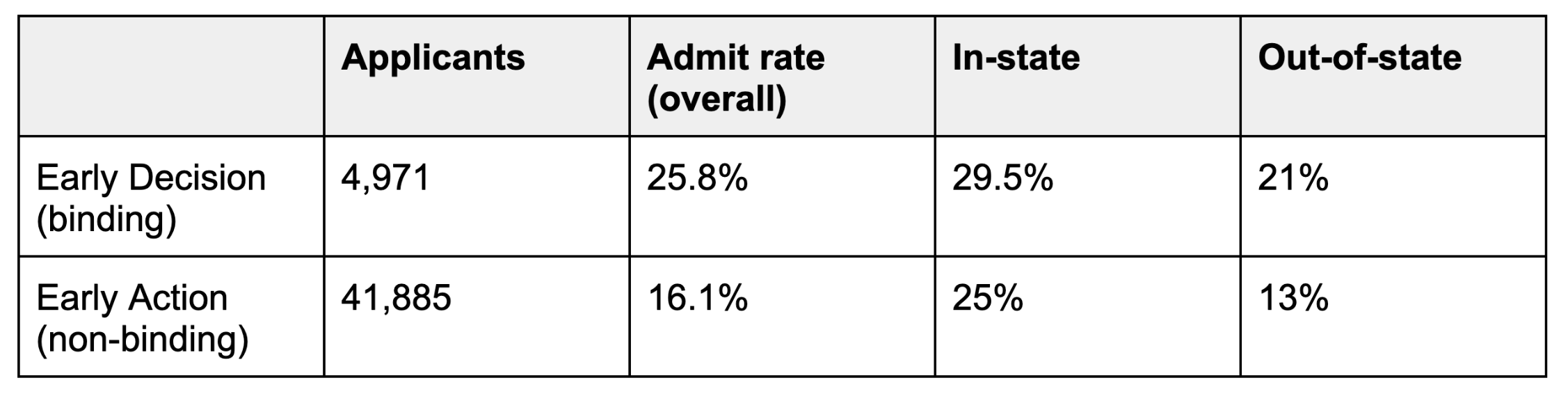
Source: College Kickstart and The Cavalier Daily.
Read that table once. The binding pool was less than one-eighth the size of the EA pool and admitted at a meaningfully higher rate. For out-of-state students the gap was widest: 21% ED against 13% EA. With UF drawing 91,896 applications for the Class of 2029, up nearly 23% from the prior year, the direction is hard to ignore.
So here’s the blunt version for Florida families. A student who would have been a comfortable EA admit last year should not assume EA is the same bet this year.
The decision framework: it's a commitment test, not a stats test
Our UF post lays out the academic profile bands. Those matter. But the question that actually decides ED is not a number. It is a single sentence:
Would this student enroll today, at the projected net price, without seeing another offer?
If the honest answer is yes, you have an ED candidate. If the answer is "UF is my top choice, but FSU is my backup," you do not. That second sentence came up almost verbatim in a counseling session this week, and it is the clearest possible sign that a student is not ready for a binding commitment. ED is not a way to hedge. It’s the opposite of hedging.
That leads to three rules our team applies:
One ED, one EA. You cannot apply binding ED to both UF and FSU. If one is a genuine first choice, apply ED there and Early Action to the other. The EA application keeps the second flagship live without violating the ED agreement.
If you can't rank them, that's your answer. A student who truly cannot choose between UF and FSU should not use ED at either. Apply EA to both and decide in spring with full information. ED is the wrong tool for a coin flip.
ED tips the committed in-range student, not the long shot. The early-round advantage is real, but it rewards a committed applicant whose grades and scores already sit inside the school's admitted range. It does not rescue a student well below it.
The trap nobody's flagging: Honors Program decisions land after you're already bound
Here is a complication that does not appear in most ED coverage, and it surfaced in our meeting because it is going to catch families off guard.
At FSU in particular, the Honors application and its essay prompt have in recent cycles opened later than the main application. We are verifying the exact Fall 2027 timeline now, but if that pattern holds, it creates a real problem for a binding applicant. A student could be admitted ED, and therefore locked in, before ever learning whether they were accepted into the Honors Program.
For UF and FSU, Honors is not a minor footnote. It affects course access, scheduling, and the ability to graduate in four years rather than stretching longer. For many students, the Honors Program is a meaningful part of why the school was appealing in the first place. Committing to the university before the Honors decision arrives means committing without one of the facts that should inform the choice.
Our advice: if Honors is material to why a student wants UF or FSU, weigh that before choosing ED over Early Action. We are confirming Honors timelines directly with both schools, because a binding decision should never be made around a question mark.
What this means for your summer
The new calendar compresses everything. October 15 is closer than it looks once you count back through essays, testing, and the conversations that should precede a binding commitment.
Visit now, while school is in session. You cannot ask a student to make a binding, four-year commitment to a campus they have only seen online. This applies most to current 9th, 10th, and 11th graders. Get on campuses while classes are running and students are actually there.
Submit every Early Action application well before deadline, even if you are applying ED somewhere. Do not wait on an ED result to submit the rest. More students will apply early this year, so falling behind on the rest of the list is a mistake you choose, not one the calendar forces on you. Treat the ED submission as one piece of a fall plan, not the whole plan.
Lock testing by early October. Any score meant for an October ED file needs to be in hand before the deadline, not hoped for afterward.
Have the family commitment conversation by August. ED is a decision parents and students make together, with the net price calculator open. Make it deliberately, not in the panic of an October deadline week.
The families who will do well under this new structure are the ones who plan early and commit deliberately. That has always been true, and our recent acceptances reflect it across UF, FSU, and schools far beyond Florida. Binding ED at both flagships just raised the cost of waiting. For a fuller view of the early-application landscape, our breakdown of Early Action versus Early Decision walks through how the two plans differ and when each one fits.
Frequently Asked Questions
Does applying Early Decision to UF or FSU actually improve my chances?
Likely yes, but treat it as a tiebreaker, not a guarantee. At comparable public flagships that run binding ED, early-round admit rates run higher than Regular Decision and the applicant pool is smaller. UF and FSU have not released ED-specific rates yet, since Fall 2027 is the first cycle. The advantage only helps a committed student already in range.
Will Early Action be harder now that UF and FSU have Early Decision?
Probably. Every seat a school fills through binding ED is a seat removed before the EA pool is read. Students admitted ED are locked in, which protects the school's yield and shrinks the number of seats left for Early Action. A student who was a comfortable EA admit in past cycles should not assume the same odds this year.
Can I apply Early Decision to both UF and FSU?
No. Binding Early Decision is a single-school commitment. You may apply ED to one flagship and Early Action to the other, but applying ED to both violates the agreement and can result in rescinded admissions at every school involved.
What if I love UF, but FSU is my backup?
Then you are not ready for Early Decision at either. Binding ED is for a clear, unconditional first choice. If a student genuinely cannot rank the two schools, the correct move is Early Action to both, then a spring decision with full aid and Honors information in hand.
Will I know about the Honors Program before I have to commit to Early Decision?
Often no, especially at FSU, where the Honors application and essay open later in the cycle. A student can be admitted and bound through ED before the Honors decision is released. If Honors is central to why a student wants the school, that timing should factor into the ED-versus-EA choice.
JRA Educational Consulting helps Florida families decide when a binding commitment is the right strategy and when it is a costly mistake, across UF, FSU, and every school on the list. To talk through whether Early Decision fits a specific student before the August planning window closes, visit jraconsulting.com or explore our college guidance program.
