
FSU Binding Early Decision for Fall 2027: Deadlines, Rules, and Strategy
Florida State University has just announced a binding Early Decision (ED) option for the Summer and Fall 2027 entering class – domestic students only. The change reshapes the senior-year calendar, the financial conversation, and the level of commitment required at the front end of the application cycle. ED will run alongside the existing non-binding Early Action plan, with both sharing an October 15 deadline and a December 17 decision release.
The university is framing the change as a response to surging application volume and a desire to give students a clear way to demonstrate that FSU is their first-choice institution. Applicants and parents need to understand how the new plan works before October.
Bottom line for most Florida families: apply Early Action, not Early Decision. EA gives priority merit consideration and a December 17 decision without the binding commitment, preserving the ability to compare offers in the spring. ED is the right call only when FSU is unequivocally your first choice and your family is ready to commit financially without comparing aid packages from other schools. Applying ED to a college tends to give an applicant more of an admissions advantage than EA, and EA tends to give more of an advantage than applying regular decision. Will that hold true for FSU? Only time will tell, but we suspect that it will!
What FSU's New Early Decision Plan Actually Looks Like
Early Decision at FSU is a binding agreement. In fact, the Early Decision Agreement, which is part of the application, must be signed by the student, a parent or guardian, and the school counselor. All three signatures are required; the agreement is the contract that makes the commitment binding. Students who apply ED commit to enroll if admitted. They must withdraw all other college applications and submit an enrollment deposit by January 15, and
When is the FSU Early Decision deadline?
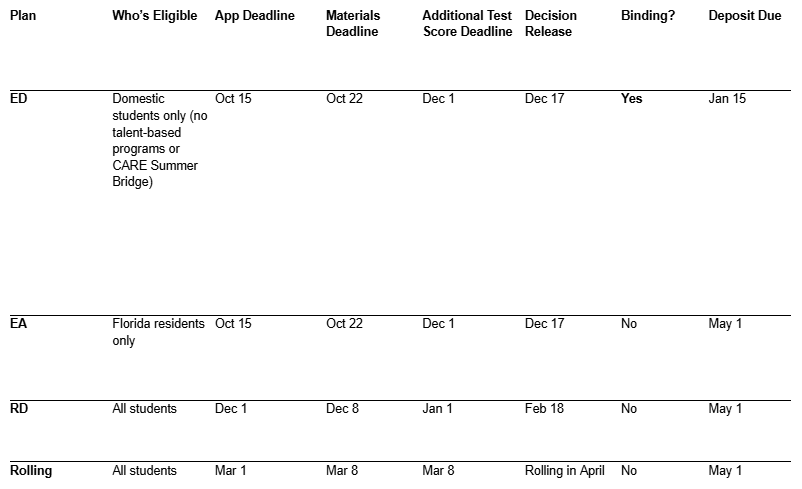
The FSU Early Decision deadline is October 15, 2026, for the Summer and Fall 2027 entering class. All required materials must be submitted by October 22, with self-reported test scores allowed through December 1. Decisions are released on December 17, and admitted students must submit their enrollment deposit by January 15.
The key dates and structure for the Summer/Fall 2027 cycle are:
Application timeline at a glance:
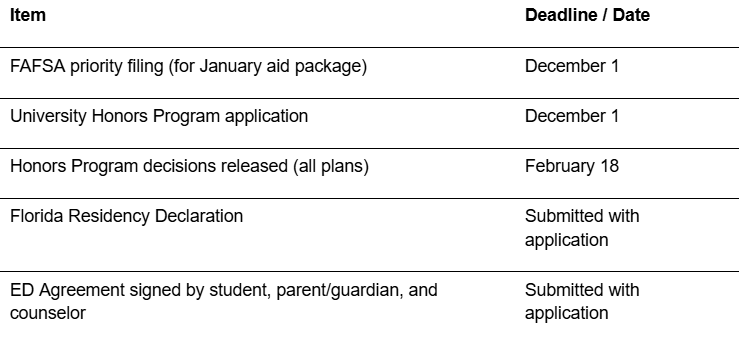
Other dates Florida families should put on the calendar:
ED applicants will receive one of three decisions on December 17: Admit, Defer, or Deny.
A defer rolls the application into the Regular Decision pool for a final decision on February 18 and lifts the binding commitment. Deferred applicants must complete the Deferral Reply Form in the FSU Admissions Portal to remain under consideration. A deny is final – denied ED applicants cannot be reconsidered at FSU during the same admissions cycle and would need to reapply later after earning an Associate in Arts degree or completing 60+ semester hours elsewhere.
Early Decision applicants are reviewed using the same holistic process (an admissions review that weighs grades, test scores, essays, activities, and context together rather than relying on cutoffs) as every other applicant. There is no separate ED scholarship application: ED applicants receive full consideration for merit aid, with awards delivered alongside the admission notification. Students applying to the University Honors Program must submit the Honors application by December 1, with all Honors decisions released on February 18, regardless of application plan.
Why FSU Is Adding Early Decision Now
FSU's first-year application volume has grown sharply over the last several admissions cycles, mirroring a national pattern of record application counts. ED gives the university a tool to identify the students most committed to enrolling, which improves yield predictability and allows admissions officers to shape the class more deliberately.
The logic mirrors what has driven ED's rise across selective admissions: demonstrated interest, a focused application, an earlier finish line. At highly selective institutions, ED has become a primary class-building lever:
Vanderbilt fills more than 50% of its incoming class through ED1 and ED2 combined.
Tulane admitted roughly two-thirds of the Class entering in fall 2026 through Early Decision.
Penn and Cornell each enroll approximately half of their freshman class from early application rounds.
At schools like Brown, Duke, and Dartmouth, ED admit rates run two to four times higher than Regular Decision admit rates at the same institutions, though ED pools tend to comprise self-select stronger candidates, so the comparison is not apples-to-apples. We covered the full data picture in our why applying early has never mattered more analysis.
FSU itself has stated that it does not yet have historical data on how its plans will compare. That candor matters. The institutions where ED produces the largest admit-rate gap are private schools with decades of binding-cycle history. FSU is starting fresh, and the first cycle's numbers will tell the real story. We dug into the broader trend lines in our 2025 Trends in College Admissions webinar, where we walked through how ED, EA, waitlists, and yield management are reshaping the landscape.
Who Should Apply Early Decision to FSU
FSU has been clear that ED is not for everyone. The plan is appropriate for a narrow category of student.
A strong ED candidate at FSU typically meets all of the following:
FSU is the clear, unequivocal first choice, not one of several near-equal favorites
The student's 9th-11th grade transcript and current ACT, CLT, or SAT scores already represent their strongest academic profile
The family is comfortable with the anticipated financial commitment without comparing aid offers from other schools
The student is ready to meet the October 15 deadline with a polished application, including the essay, activities resume, the Self-reported Transcript and Academic Record System (STARS), the signed ED Agreement, and the Florida Residency Declaration if applicable
Several groups are not eligible for ED at FSU and must apply through Early Action or Regular Decision:
International applicants
Students applying through talent-based programs: Acting BFA, Athletics, Dance, Film, Music, Music Theatre, Stage Management BFA, and Studio Art BFA
Students applying to the CARE Summer Bridge Program (which follows a separate admissions track)
For Florida residents who are still weighing FSU against the University of Florida or another top option, Early Action remains the smarter play. EA still gives students priority merit consideration and a December 17 decision without the binding commitment, preserving the ability to compare offers in the spring. The strategic difference between Early Action and Early Decision is the conversation families need to have first, before any application is filed.
The Financial Question Families Must Answer Before Applying ED
Binding admission means the family has effectively closed the door on comparing aid packages from other schools. That is the single biggest tradeoff in any ED decision, and it demands a deliberate conversation.
For Florida families, the conversation is especially loaded. Bright Futures, Florida Prepaid, and the Benacquisto Scholarship all run on their own award timelines, and a binding ED commitment to FSU forecloses the option to weigh a state-aid package against an out-of-state offer that might land later. An admitted ED student must withdraw applications to every other college, and that withdrawal most likely happens before most need-based and merit packages from competing schools are issued. Families relying on layered state and federal aid need to model the full package against FSU's Net Price Calculator output before committing, not after.
FSU has built several safeguards into the new plan:
Net Price Calculator: FSU's online tool that estimates a family's actual cost after grants, scholarships, and need-based aid. Families considering ED are encouraged to model potential costs and aid eligibility before submitting an application.
Early FAFSA timing: ED applicants who submit the Free Application for Federal Student Aid (FAFSA) by December 1 should receive their financial aid package in January, before the January 15 deposit deadline.
Release for financial hardship: In limited cases, a student may request release from the ED agreement if the financial aid package does not make attendance feasible. These requests are reviewed case by case in coordination with Financial Aid, the Office of Admissions, and the family. If granted, the acceptance is withdrawn and the applicant cannot be reconsidered in a later non-binding round at FSU.
FSU gives priority merit-scholarship consideration to ED and EA applicants, with awards delivered alongside the admission notification. That makes early application meaningful for affordability. But a student should never apply ED without first running the Net Price Calculator, modeling realistic costs, and confirming the family can commit financially to whatever package is offered.
How FSU Early Decision Changes Strategy for the 2026–2027 Application Cycle
The addition of ED at FSU forces a recalibration for any rising senior considering the school. Families should be working through several decisions earlier than they may have planned.
Strategic priorities for current juniors and rising seniors:
Lock in the testing calendar early. ED applicants need a competitive ACT, CLT, or SAT score on file for the October 15 submission. Additional scores can be self-reported through December 1, but waiting on a December test result is risky for ED. A clear testing plan built around the application calendar is essential.
Finalize the school list by August. ED demands a real first-choice school. Families should be visiting campuses, comparing fit, and pressure-testing the FSU decision well before senior year begins.
Complete the STARS by August. FSU still requires the Self-reported Transcript and Academic Record System for any application plan. Building it accurately and on schedule is non-negotiable.
Draft essays in summer, not fall. ED applications are due October 15. A polished essay and activities resume requires summer work.
Plan the FAFSA timeline. Submit by December 1 to receive the aid package in January, before the deposit deadline.
For families also targeting other Florida public universities, stacking strategies across UF, FSU, and the broader Florida State University System becomes more nuanced. An ED admit at FSU forces the student to withdraw applications elsewhere, removing the option to compare admissions decisions or aid packages in the spring. Students can still apply to other SUS schools while ED is pending: they just must withdraw upon ED admission. For a side-by-side look at admissions stats, score ranges, and deadlines for all 12 Florida public universities, our SUS admissions data resource is the cleanest comparison tool.
What Happens If You Are Deferred from FSU Early Decision
A defer is meaningful at FSU under the new system. Deferred ED applicants are released from the binding commitment and roll into the Regular Decision review pool, with a final decision on February 18. To remain under consideration, deferred applicants must complete the Deferral Reply Form on their Admissions Portal.
If admitted in February, deferred applicants have until May 1 to commit to enroll. A defer effectively converts the application into a non-binding one, which removes the financial commitment problem but extends the timeline. Students who receive a deferral should treat the next eight weeks as their second application: send fall semester grades, submit a concise letter of continued interest, share any new awards or scholarship news, and make the case for Regular Decision admission. The right response to a deferral often determines whether the February 18 decision flips from defer to admit.
The Bigger Picture: What FSU's Move Means for Florida Families
Binding Early Decision has historically been the territory of selective private universities. Its expansion into the State University System is new territory, and other public flagships are likely to follow as application volumes continue to climb. The traditional Florida-resident default of "apply EA to UF, FSU, and UCF and compare offers" still works, but layering FSU's new ED on top of that approach demands a clear hierarchy of choice. Applicants need to know, with confidence, what their first-choice school actually is, and they need to know it earlier than ever.
FSU's announcement is not a reason to rush into ED. It is a reason to make a deliberate decision earlier in the process. ED is a tool that rewards certainty. Used well, it can accelerate the path to a strong outcome at a first-choice school. Used poorly, it can lock a family into a financial commitment they cannot meet, or close the door on better aid offers elsewhere. The right answer for any individual student depends on academic profile, financial picture, college list, and readiness, and those four variables need to be weighed together well before October 15. Families who are uncertain should default to Early Action or Regular Decision: both remain non-binding, and both still receive full holistic review and merit-scholarship consideration.
That kind of clarity rarely happens by accident. It comes from disciplined college research, structured campus visits, honest conversations about fit and finances, and a coherent college admissions strategy that aligns testing, essays, and timeline with each school's specific requirements. The students who will thrive under FSU's new system are the ones who have done that work before October of senior year.
Schedule an ED-versus-EA strategy call with JRA Educational Consulting before August. We help families work through exactly the decisions FSU's new Early Decision plan demands: ED-versus-EA fit, Net Price Calculator interpretation, binding-commitment readiness, and a complete application strategy across the Florida State University System and beyond. Visit jraconsulting.com or explore our College Application and Essay Packages.
