
Should You Commit to a College Before FAFSA Verification Is Complete?
The May 1 college commitment deadline is approaching, and thousands of families across the country are staring at the same question: How do we commit to a school when we still don't know what it will actually cost?
If your student has been selected for FAFSA verification, this question hits even harder. The financial aid package sitting in your portal right now may not be final. Documents are still being reviewed. And the clock is ticking on that enrollment deposit.
What FAFSA Verification Actually Means (And Why It's Usually Fine)
Here is the data that should frame everything else in this article: more than 70% of students selected for FAFSA verification see no change to their Pell Grant award. Among the lowest-income applicants, that number climbs to 93–96%. A 2020 analysis by the National College Attainment Network, using federal data from the Department of Education, confirmed what financial aid professionals had long observed: verification rarely alters a student's aid. As NASFAA President Justin Draeger told *The Chronicle of Higher Education*, the data "confirmed what aid professionals have known for a long time: that at the end of the day, most verifications result in no change in grants for students."
So what is verification? It is essentially a federal audit. The Department of Education flags certain FAFSA applications for a closer look, and the college's financial aid office requests additional documentation (tax returns, W-2 forms, or other records) to confirm the data you submitted is accurate.
Roughly 18% of all FAFSA filers are selected each year. That number has actually dropped from the historical rate of 25–30%, after a Department of Education cost-benefit analysis found that verifying above 18% cost more than it saved in corrected aid. Being selected is not a red flag. It does not mean you made a mistake. It does not mean your aid is in jeopardy.
The real risk is not that verification will reduce your aid. The real risk is not completing it. According to the same NCAN research, roughly 25% of Pell-eligible students selected for verification fail to submit the required documents and lose access to federal aid entirely. That is thousands of dollars left on the table because of paperwork that never got turned in.
The May 1 College Admissions Deadline – And Why It's Tighter This Year
May 1 – National College Decision Day – remains the standard commitment deadline recommended by NACAC (the National Association for College Admission Counseling). But it is a guideline, not a federal law. Schools set their own deadlines, and many have shown flexibility in recent years.
The 2025-26 FAFSA cycle has been particularly challenging. The "Better FAFSA" redesign of the federal financial aid application pushed the application's availability to December 1, two months later than the traditional October 1 opening. Processing times were expanded from the advertised 3–5 business days to 10–21 days as the new norm. Data was released to colleges in batches rather than continuously, meaning many schools did not start assembling aid packages until mid-to-late February.
The downstream effect: families received aid offers weeks later than usual, and verification timelines got compressed further. A NASFAA survey published in August 2025 found that 72% of financial aid offices reported processing delays following federal workforce reductions, with some institutions telling students they hoped to have all packages finalized by early June.
The system's timeline has not adjusted to match the delays. In the 2024 cycle, at least 190 colleges pushed their commitment deadlines past May 1 in response to FAFSA processing delays. The GAO published a report documenting how the rollout left students and institutions scrambling.
So Should You Pay the Deposit or Wait?
The logic applies broadly, but specific numbers from the University of Missouri help clarify the real stakes.
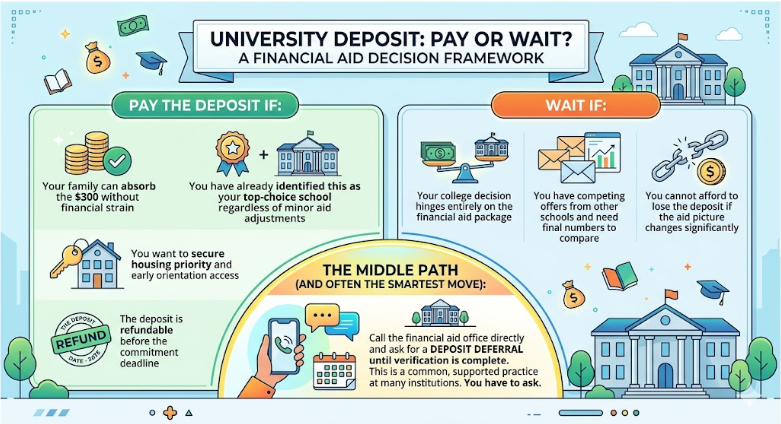
Mizzou requires a $300 enrollment fee to confirm your spot. That fee is refundable before May 1 and non-refundable after. Mizzou's financial aid office states explicitly that award notifications are not considered final until verification is complete, and that awards may be revised based on corrections. There is no published policy for extending the deposit deadline for students in verification.
The deposit is not the only thing at stake. At Mizzou, room selection access times are assigned based on when you signed your housing contract. Earlier signers get earlier picks in June. Students who complete their contract after May 1 receive their next steps later in the summer, which typically means less desirable halls and fewer roommate-matching options. Orientation registration requires the enrollment fee to be paid before you can even access the sign-up form, and earlier sessions mean better course availability during advising. Every week of delay cascades.
Here is the decision framework:
Five Steps Every Family Should Take Right Now
If your student is in FAFSA verification and a commitment deadline is approaching, here is exactly what to do:
1. Submit every verification document immediately. Do not wait. Do not batch them. Every day of delay extends the timeline. Most schools estimate a minimum of two weeks for verification processing after all documents are received.
2. Call the financial aid office. Not email. Call. Ask three specific questions: (a) Is my current aid estimate likely to change after verification? (b) Can the deposit deadline be extended until verification is complete? (c) If my aid changes after I commit, what are my options?
3. Get the refund policy in writing. Understand exactly when deposits become non-refundable. If the deposit is refundable before May 1 and you are confident verification will resolve by then, the financial risk is low. Note that May 1 is the standard NACAC deadline. Some schools may offer later deadlines, and rolling admissions or waitlist situations can affect timing as well. Confirm your school's specific date rather than assuming.
4. Do not double-deposit as a strategy. Some families put deposits at two schools as a hedge. This is against NACAC guidelines, and it can backfire. Schools communicate with each other, and if one discovers you have committed elsewhere, it can complicate your standing.
5. Document every interaction. Create a dedicated folder (email or physical) for your verification process. After every phone call, send yourself an email noting the date, time, name of the person you spoke with, and what was agreed to. Screenshot your financial aid portal after each document upload. Save every confirmation email. If there is a dispute about timing later, this paper trail protects you.
What Admissions Professionals Are Saying
Independent educational consultants across the country are guiding families through this exact scenario right now. The consensus among college admissions professionals is clear: verification is routine, not catastrophic. The system is designed to confirm accuracy, not to punish families.
Florida-based counselors are reporting that the combination of FAFSA Simplification Act changes and federal workforce reductions has created genuine processing bottlenecks. But the advice remains the same: respond quickly, communicate with schools directly, and do not let uncertainty about verification freeze your entire college decision.
The families who struggle most are the ones who freeze. They wait for perfect information before making any decision, and in doing so, they miss deadlines, lose housing assignments, and create unnecessary stress for their student during a period that should be exciting.
The Bottom Line
For most families, the answer is yes: commit to your school, especially when the deposit is refundable. But do it strategically.
FAFSA verification is not a reason to panic. It is a reason to act. Submit your documents today. Pick up the phone and call the financial aid office tomorrow. Get clarity on deposit refund policies and deadline flexibility.
For most families, the right move is to secure your spot while verification plays out, especially when deposits are refundable. The statistical reality is on your side: more than 70% of verified students see no change to their aid. The families who come through this smoothly are the ones who treat it as a communication challenge, not a financial crisis.
If your family is navigating FAFSA verification, competing financial aid offers, or a commitment decision that feels like it is moving faster than the information you need, JRA Educational Consulting can help. We work with families through every stage of the college admissions process, including financial aid review and enrollment strategy. Schedule a consultation with JRA today.
