
UF Early Decision for Fall 2027: Binding Rules, Deadlines, and How It Compares to FSU
The deadline is October 15. As of this admissions cycle, the University of Florida has added a binding Early Decision pathway for Fall 2027 applicants. UF's freshman admissions page now lists three options: Early Decision, Early Action, and Regular Decision. ED carries the same binding-enrollment commitment used at Vanderbilt or Duke. If a student is admitted ED, they enroll at UF and withdraw every other college application.
UF's move follows FSU's Early Decision announcement by a matter of weeks. Both of Florida's flagship public universities now operate binding ED rounds in the same cycle, and UF's calendar is actually tighter than FSU's.
Florida's two flagships now both bind students at the application stage. The era of "apply everywhere and decide in April" is officially over for UF and FSU hopefuls.
What To Do This Week
If a rising senior is even considering UF Early Decision:
Run UF's Net Price Calculator. Know the actual cost before applying ED.
Have the first-choice conversation as a family. ED is a commitment, not a wish.
Confirm major and program eligibility under the ED pathway, especially for Honors or restricted majors.
Map the testing calendar. Any scores for ED should be in hand by early October.
Decide ED versus EA by the end of August. October 15 is six weeks of essay work away.
What UF's Early Decision Actually Looks Like
Per UF Admissions, the binding pathway works this way:
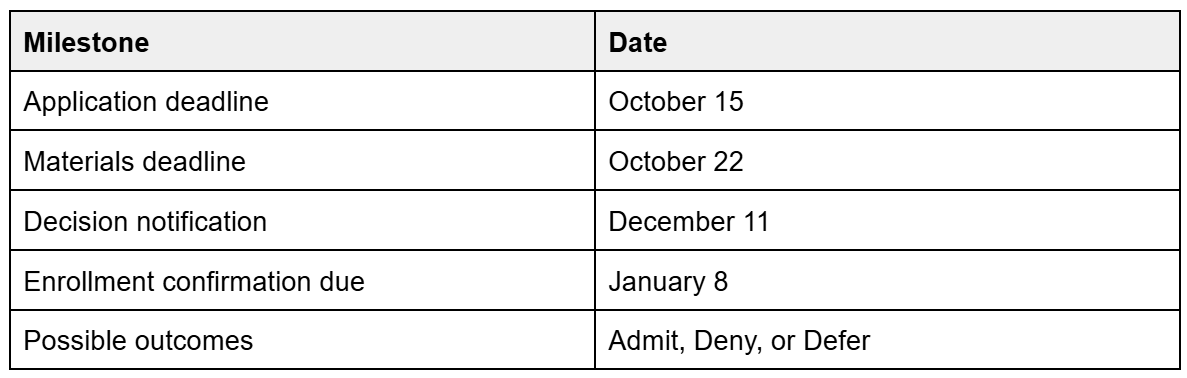
If an admitted ED student does not confirm enrollment by January 8, UF cancels the admission. Final transcripts are by due July 1, and any official test scores must be received by May 1.
Early Action and Regular Decision are unchanged. EA remains a November 1 deadline with a January 22 decision. RD remains January 15 with a March 19 decision. Both stay non-binding.
The distinction matters. An EA admit is a leverage point. An ED admit is a contract.
If a student is deferred from ED, the binding agreement dissolves and the application rolls into the Regular Decision pool with a March 19 decision. Deferred students should follow instructions to send additional materials, if any, in their decision letter. They are also free to apply ED2 to another school if a target on their list offers it.
UF vs. FSU: How to Choose When Both Are on Your List
This is the planning question I expect this summer from most rising seniors in our college guidance program.
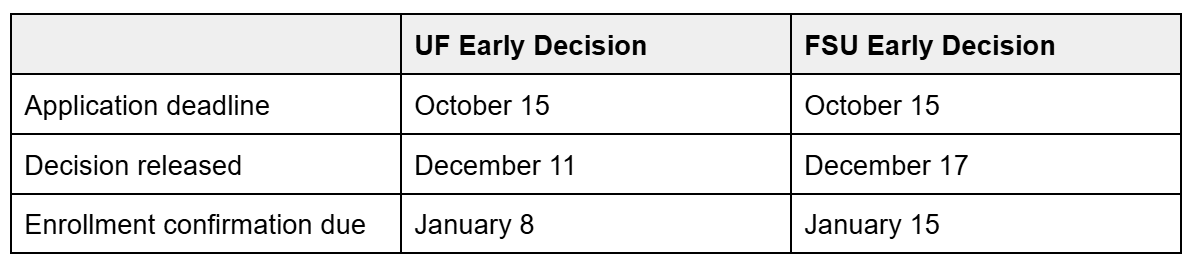
UF releases decisions six days earlier and demands the binding commitment a full week before FSU. A student cannot apply ED to both schools, because binding ED is a single-school commitment.
The cleanest decision framework:
If one of the two is a clear first choice, apply ED there and EA to the other. The EA application keeps the second flagship live without breaking ED rules.
If a student genuinely cannot rank UF and FSU, do not use ED at either. Apply EA to both and decide in spring with full aid packages in hand. ED is not the right call when the first choice is a coin flip.
If the student is targeting a competitive program (Honors, business, engineering), the early-round admit-rate advantage is meaningful, but only if the major is open under the chosen pathway.
Confirm ED eligibility for your chosen major or program before locking in.
ED is not a strategy. It is a commitment. Treat it that way.
Does UF Early Decision Affect Bright Futures or Financial Aid?
Bright Futures is awarded based on the student's academic profile, not the chosen school or admission pathway. The state scholarship piece does not depend on UF versus FSU versus an out-of-state option. The risk is everywhere else.
Binding ED locks a student in before:
The full institutional aid package from UF arrives, including Honors Program eligibility, Lombardi Scholars consideration, and Stamps Scholarship review (UF's named merit awards layered on top of Bright Futures), plus any need-based award through FAFSA.
Competing offers from peer universities arrive in March.
Merit packages from out-of-state privates, the schools that heavily discount tuition for top Florida applicants, are released.
For families who need to compare net costs, EA is the right answer. EA still delivers a January admission, still signals interest, and preserves every dollar of negotiating leverage. ED makes sense only when the family is ready to enroll at UF's projected net cost without comparing anything else.
Who Should Apply ED and Who Should Not
ED is the right call when three conditions are all true:
UF is unequivocally the student's first choice, not the parent's preference and not a hedge against rejection elsewhere.
The academic profile is well within or above the middle 50% for the most recent admitted class: 4.5-.7 weighted GPA on UF's recalculated scale, 1380-1510 SAT, 31-34 ACT. (Class of 2029 admit profile. Note that UF recalculates GPA using its own formula, which most likely differs from a student's school-reported GPA. Updated Class of 2030 data should be confirmed on UF's admissions page before applying.)
The family has run UF's Net Price Calculator and accepts the projected cost without needing to compare other packages.
ED is the wrong call when:
The student is choosing between UF and a significantly different option (FSU, an SEC peer, an out-of-state public, or a need-aware private).
Testing is still in motion and the student is hoping for a late-fall score bump.
The family will need to compare layered need-based aid before committing.
The student is targeting a talent-based program or selective major with a separate audition, portfolio, or supplemental timeline.
If the answer to any of those is yes, EA is the strategically correct choice. There is no admissions penalty for choosing EA over ED beyond the marginal admit-rate boost ED tends to provide at selective schools.
The cost of getting ED wrong is real: tens of thousands of dollars in foregone merit aid, or in the worst case, four years at a school the student no longer wants. Families weighing this decision can review JRA's recent college acceptances to see how earlier classes navigated similar choices across Florida flagships and out-of-state universities, then schedule a consultation before the August planning window closes.
Why Both Florida Flagships Moved at Once
Two flagships adopting binding ED in the same cycle is not a coincidence. UF received 91,896 applications for the Class of 2029, a 22.8% increase over the prior year. FSU's volume sat near 100,000, up 48% over five years. At that scale, both schools have the same set of problems: yield protection, predictable enrollment math, and competition with out-of-state peers in the SEC and ACC that already use binding ED to lock in committed students.
The implication for families is straightforward. The strategic advantage of applying early is no longer optional reading. The Florida public university process now rewards students who can commit in summer, not students who wait until winter to decide where they actually want to go. That favors families who plan early.
Frequently Asked Questions
When is the UF Early Decision deadline?
October 15 for the application, October 22 for materials. UF releases decisions on December 11, and admitted ED students must confirm enrollment by January 8. The $200 deposit is non-refundable.
Is UF's Early Decision really binding?
Yes. An admitted ED student must enroll at UF, withdraw all other college applications, and confirm by January 8. UF cancels the admission if confirmation does not happen. This is the same binding standard used at private universities like Vanderbilt and Duke.
Can a student apply ED to both UF and FSU?
No. Binding ED is a single-school commitment. A student can apply ED to one of the two flagships and EA to the other, but not ED to both. Applying ED to multiple schools violates the agreement and risks rescinded admissions at every school involved.
Does Early Decision affect Bright Futures?
No. Bright Futures is a Florida state scholarship awarded on the student's academic profile, not the application pathway. The real financial risk with ED is foreclosing the ability to compare institutional aid packages and merit scholarships from other universities.
What is UF's Early Decision acceptance rate?
UF has not released an ED-specific admit rate, because Fall 2027 is the first cycle the binding pathway is being offered. At peer flagships with established ED rounds, binding-round admit rates typically run higher than Regular Decision, but the size of the advantage depends on yield strategy and program selectivity. Treat the boost as a tiebreaker, not a guarantee.
JRA Educational Consulting helps Florida families build application strategies that account for binding deadlines, financial trade-offs, and the new rules at UF, FSU, and beyond. To talk through whether ED is the right call for a specific student, visit jraconsulting.com.
